
WeBER Policy Briefs
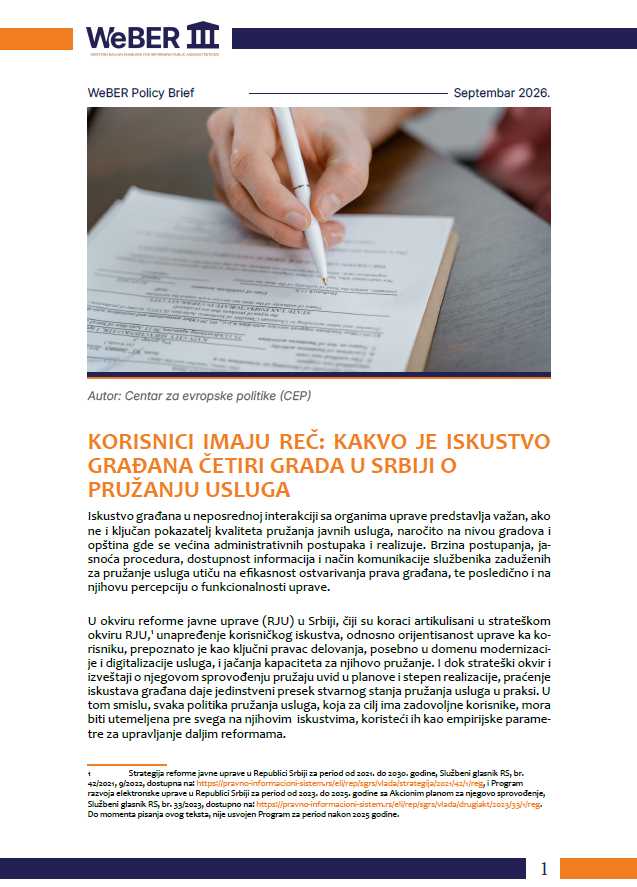
Korisnici imaju reč: Kakvo je iskustvo građana četiri grada u Srbiji o pružanju usluga
Iskustvo građana u neposrednoj interakciji sa organima uprave predstavlja važan, ako ne i ključan pokazatelj kvaliteta pružanja javnih usluga, naročito na nivou gradova i opština gde se većina administrativnih postupaka i realizuje. Brzina postupanja, jasnoća procedura, dostupnost informacija i način komunikacije službenika zaduženih za pružanje usluga utiču na efikasnost ostvarivanja prava građana, te posledično i na njihovu percepciju o funkcionalnosti uprave. U okviru reforme javne uprave (RJU) u Srbiji, čiji su koraci artikulisani u strateškom okviru RJU, unapređenje korisničkog iskustva, odnosno orijentisanost uprave ka korisniku, prepoznato je kao ključni pravac delovanja, posebno u domenu modernizacije i digitalizacije usluga, i jačanja kapaciteta za njihovo pružanje. I dok strateški okvir i izveštaji o njegovom sprovođenju pružaju uvid u planove i stepen realizacije, praćenje iskustava građana daje jedinstveni presek stvarnog stanja pružanja usluga u praksi. U tom smislu, svaka politika pružanja usluga, koja za cilj ima zadovoljne korisnike, mora biti utemeljena pre svega na njihovim iskustvima, koristeći ih kao empirijske parametre za upravljanje daljim reformama. Preuzmite brif ovde: SRB | ENG
Between Merit System and Discretion: Challenges of the Draft Law on Senior Civil Servants
This brief reflects on the developments as of February 2026, when, after a prolonged period of delay and uncertainty, a broad and substantive discussion on the draft law was finally opened. From the very beginning of the law’s drafting, EPI has continuously provided comments and recommendations through its public administration reform monitoring reports and policy briefs. Throughout this process, we have repeatedly raised concerns over the Government’s apparent hesitation to adopt the law and questioned why establishing clear criteria and a transparent procedure for the selection of senior management officials has proven to be such a persistent challenge. Download the brief here: ENG | MKD
For a Merit-Based Local Civil Service: What a Dedicated Law Must Address
Employment in local administrations has been largely neglected in terms of monitoring the implementation of key regulations and establishing standards in this area. Paradoxically, following the 2021 amendments to the Law on Civil Servants and State Employees, which degraded employment conditions in state administration bodies, recruitment procedures have become comparatively more advanced at the local level than in other parts of the public sector (state administration, public enterprises and public institutions). However, this “comparative advantage” is highly relative, as it stems solely from loose procedures and the absence of basic safeguards for merit-based recruitment in other sectors. Additionally, there have been several attempts to align employment conditions in local administrations with those at the state level, thereby effectively weakening them. The proposed Draft Law on Local Civil Servants and Employees partially realises these attempts, given that it offers the possibility for acting officials to be appointed from outside the local self-administration system, without prior checks. The Government, taking into account suggestions from stakeholders, primarily municipalities, initiated the drafting of a dedicated Law on Local Officials, Civil Servants and Employees in 2024. According to the Ministry of Public Administration, which is leading this process, the Draft Law aims to [...]
The Endless Cycle of Amending the Law on Free Access to Information
The Law on Free Access to Information is one of the main tools used by research centers, non-governmental organisations, and the media. In Montenegro, the current Law was adopted in 2012 with the aim of establishing a legal framework aligned with European standards in the field of free access to information. The amendments introduced five years later further narrowed the scope of access to information held by public authorities. Over the past 13 years, since its adoption in 2012 until 2025, the Law has undergone only one set of amendments, adopted in 2017. In the meantime, there have been several attempts over the past five years to adopt amendments to the Law; however, these proposals never reached consideration in Parliament, as they were either archived or withdrawn. In July 2024, the Government formed a working group to draft a new Law, which further delayed the improvement of the legal framework for free access to information. The draft of the new Law on Free Access to Information has been in parliamentary procedure for nine months, since February 2025. The aim of this report is to provide an overview of the chronology of amendments to the Law on Free Access [...]
For More Professional Hospitals, Schools and Public Institutions: Our key recommendations for the Law on Public Institutions
Public institutions founded by the state employ 30,170 people, accounting for more than half of all employees in central-level public administration. According to the Open Data Portal, there are 324 public institutions in Montenegro. Despite their significant role, employment and labour relations within these institutions remain largely neglected. They are most often governed either solely by general labour regulations or by inadequate legislation that fails to recognise their specific importance in advancing the public interest, delivering public services, and establishing a merit-based and transparent system. The extent of this neglect is reflected in the fact that only with the adoption of the current Public Administration Reform Strategy 2022–2026 was an official record of the number of employees established, covering public institutions at both central and local levels. The Strategy also highlighted the absence of a unified normative framework regulating public institutions that provide services to citizens and legal entities in areas such as health care, education, culture, sport, social and child protection, and pension and disability insurance. At the same time, it noted that Montenegro, unlike neighbouring countries, does not have a dedicated Law on Public Institutions, but instead regulates this field partially through sectoral laws in the [...]
Acting Appointments: From Phenomenon to Abuse
Group for Legal and Political Studies (GLPS) has consistently tackled the phenomenon of acting appointments as a dangerous phenomenon for public administration, warning institutions about the situation and its consequences, as well as providing a series of recommendations on how to address and overcome this situation. On the contrary, the situation has worsened both at the level of legal framework and in practice. Acting appointments are turning as one of the main tools of daily politics for intervention in the public service, minimizing the meritocracy and professionalism of the public administration. Acting appointments are not an isolated phenomenon in our country but also in other countries, including those in the Balkans and in countries that are part of the European Union. The SIGMA/OECD Toolkit 1on Temporary Appointments addresses precisely the phenomenon of acting officials, providing a valuable set of solutions on how to manage acting appointments without violating the fundamental principles of the public service. Although the toolkit clarifies how the risk in these situations can be reduced, at the same time it reiterates the fact that in order to ensure good and sustainable management, the functioning of acting appointments must be prevented and reduced. This brief analysis [...]