
After the Surname Changes: From Scattered Procedures to a Unified Life-Event Service
Life events are the moments when citizens face the most frequent and complex interactions with the administration. This is why the OECD Recommendation on Human-Centred Public Administrative Services (2024) and the SIGMA Principles of Public Administration, against which Serbia’s accession progress is assessed, require services to be organised around life events and co-created with users. Despite progress such as the eBaby service, many life events in Serbia still require citizens to obtain services one institution at a time. Changing one’s last name after marriage or divorce is one of them: it triggers more than a dozen separate, uncoordinated procedures, with no unified service to connect them.
This affects a large number of people every year. In 2025, more than 29,000 marriages were concluded and over 10,000 divorces recorded, a large share of them involving a last name change. The burden falls in a large majority of cases on women – between 2000 and 2018, only 2,356 men took their wife’s last name – which makes a unified service a gender-responsive public service as well.
In the worst-case scenario analysed in this brief, re-establishing one’s identity requires five procedures for personal documents, one for registering a new residence, seven for data in registers and databases, and a “hidden” fourteenth: updating the eGovernment Portal account, without which most other online services remain out of reach. Only six of the 14 procedures can currently be completed online without a visit, and four only partly; the ID card, passport and vehicle registration certificate each require at least two visits to a police station; and fees, paid separately, total more than 14,000 RSD. Even finding out what you need to do is difficult: the Portal’s life event section only links to appointment scheduling, lists only four of the five documents in its part on marriage and says nothing about fees. Moreover, citizens’ obligations are spread across at least ten legal acts, with no official guidebook.
A focus group with six women and in-depth interviews with five showed how this plays out in practice: lack of coordination between institutions, repeated visits, carrying documents between institutions although the law obliges institutions to exchange them, and reliance on blogs and lawyers’ websites in the absence of clear instructions. All of this comes at an emotionally and financially demanding moment, in a change experienced as deeply identity-related.
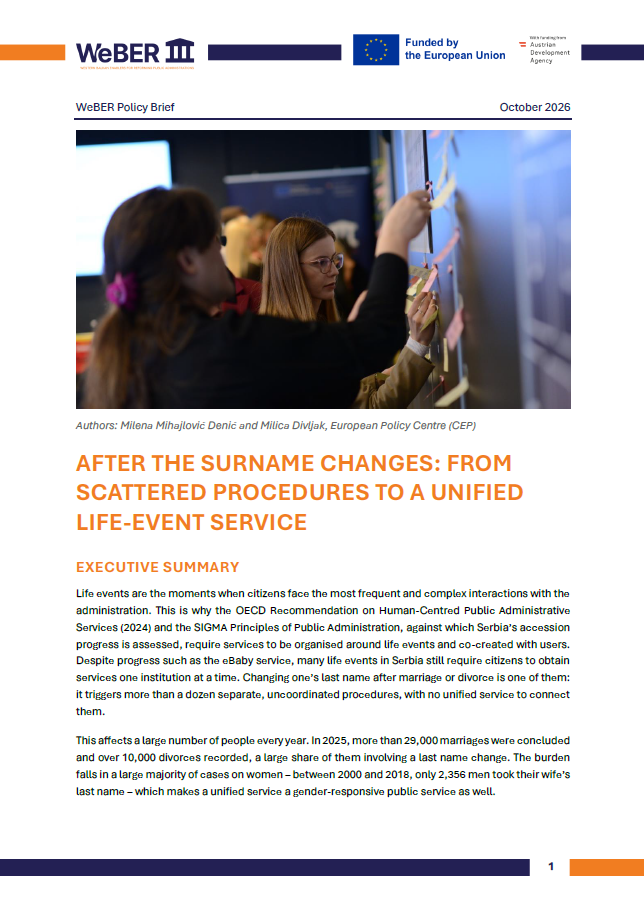
To address these problems, the WeBER Policy Lab brought CEP together with the Public Policy Secretariat, the Ministry of Public Administration and Local Self-Government, the Ministry of Internal Affairs and the Office for IT and eGovernment. At a design thinking workshop in May 2025, the participants co-created two prototypes – a unified e-service on the Portal and a unified request form for one-stop shops – and agreed that any solution must be accompanied by an authoritative guidebook for citizens, in print and digital form and written in simplified language. Although the research, the co-created design and donor resources were in place, testing and production have been postponed due to the prolonged political crisis.
Building on this work, the brief proposes two unified services, for personal documents and for data in registers, delivered online through the eGovernment Portal and physically through one-stop shops. The recommendations focus on:
- establishing both online and offline services based on the Policy Lab prototypes;
- updating the eGovernment Portal account automatically as soon as the new ID card with an electronic certificate is issued, while allowing users to start the service with their existing credentials;
- standardised requests requiring only basic information from the citizens, with a single itemised payment order, status tracking and SMS confirmations;
- strengthening inter-institutional data exchange and the application of the once-only principle;
- production of an official guidebook, “You have changed your last name – what now?”, staff training and a feedback mechanism reported on annually.
Download the brief here.
After the Surname Changes: From Scattered Procedures to a Unified Life-Event Service
Life events are the moments when citizens face the most frequent and complex interactions with the administration. This is why the OECD Recommendation on Human-Centred Public Administrative Services (2024) and the SIGMA Principles of Public Administration, against which Serbia’s accession progress is assessed, require services to be organised around life events and co-created with users. Despite progress such as the eBaby service, many life events in Serbia still require citizens to obtain services one institution at a time. Changing one’s last name after marriage or divorce is one of them: it triggers more than a dozen separate, uncoordinated procedures, with no unified service to connect them.
This affects a large number of people every year. In 2025, more than 29,000 marriages were concluded and over 10,000 divorces recorded, a large share of them involving a last name change. The burden falls in a large majority of cases on women – between 2000 and 2018, only 2,356 men took their wife’s last name – which makes a unified service a gender-responsive public service as well.
In the worst-case scenario analysed in this brief, re-establishing one’s identity requires five procedures for personal documents, one for registering a new residence, seven for data in registers and databases, and a “hidden” fourteenth: updating the eGovernment Portal account, without which most other online services remain out of reach. Only six of the 14 procedures can currently be completed online without a visit, and four only partly; the ID card, passport and vehicle registration certificate each require at least two visits to a police station; and fees, paid separately, total more than 14,000 RSD. Even finding out what you need to do is difficult: the Portal’s life event section only links to appointment scheduling, lists only four of the five documents in its part on marriage and says nothing about fees. Moreover, citizens’ obligations are spread across at least ten legal acts, with no official guidebook.
A focus group with six women and in-depth interviews with five showed how this plays out in practice: lack of coordination between institutions, repeated visits, carrying documents between institutions although the law obliges institutions to exchange them, and reliance on blogs and lawyers’ websites in the absence of clear instructions. All of this comes at an emotionally and financially demanding moment, in a change experienced as deeply identity-related.
To address these problems, the WeBER Policy Lab brought CEP together with the Public Policy Secretariat, the Ministry of Public Administration and Local Self-Government, the Ministry of Internal Affairs and the Office for IT and eGovernment. At a design thinking workshop in May 2025, the participants co-created two prototypes – a unified e-service on the Portal and a unified request form for one-stop shops – and agreed that any solution must be accompanied by an authoritative guidebook for citizens, in print and digital form and written in simplified language. Although the research, the co-created design and donor resources were in place, testing and production have been postponed due to the prolonged political crisis.
Building on this work, the brief proposes two unified services, for personal documents and for data in registers, delivered online through the eGovernment Portal and physically through one-stop shops. The recommendations focus on:
- establishing both online and offline services based on the Policy Lab prototypes;
- updating the eGovernment Portal account automatically as soon as the new ID card with an electronic certificate is issued, while allowing users to start the service with their existing credentials;
- standardised requests requiring only basic information from the citizens, with a single itemised payment order, status tracking and SMS confirmations;
- strengthening inter-institutional data exchange and the application of the once-only principle;
- production of an official guidebook, “You have changed your last name – what now?”, staff training and a feedback mechanism reported on annually.
Download the brief here.